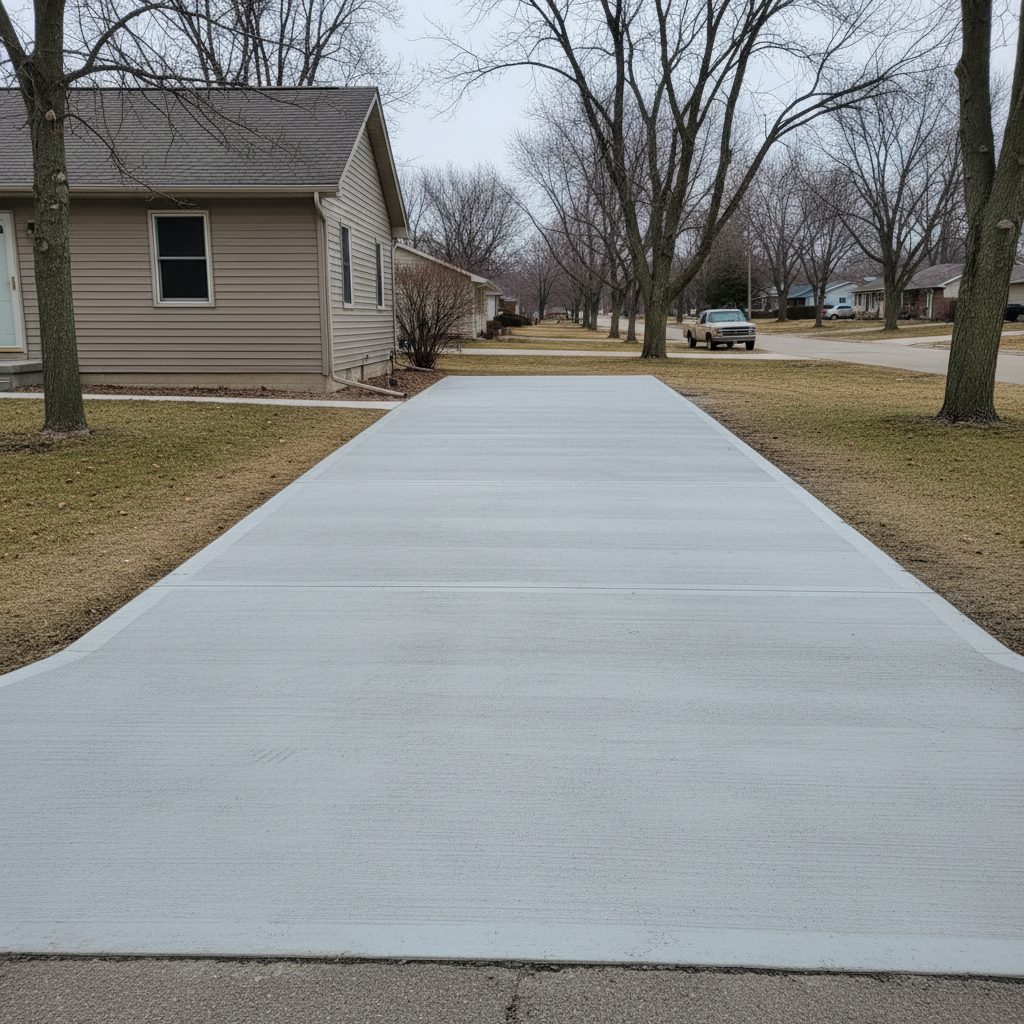
Concrete looks simple from the outside. Gray stuff, poured flat, left to harden. The part a homeowner doesn't see is the six inches of compacted base underneath, the depth the footings go to beat frost heave, and whether the crew bothered to cut control joints before the slab cracked on its own terms instead of the contractor's. Picking the wrong person for this work doesn't usually show up for a year or two, which is exactly why it's worth slowing down now.
What the ground here actually does to concrete
Onalaska sits where the Black River meets the Mississippi, and the soil varies a lot depending on which side of town you're on. Closer to the river and out toward French Island, you're often dealing with sandy, fast-draining soil and a water table that can sit closer to the surface than people expect. Further up the bluffs and out toward Medary or County Road M, you run into heavier clay subsoil that holds water and swells and shrinks with the seasons. A contractor who's worked here knows which lots need extra base material, which ones need a sump or drain tile before anything gets poured, and which ones are fine with a standard 4 to 6 inch gravel base compacted in lifts.
Wisconsin's frost depth code generally puts footings at 42 to 48 inches. A contractor quoting a foundation or frost footing that doesn't mention frost depth at all, or just says "we'll dig it deep enough," isn't someone who's thinking about your specific lot.
What a real quote looks like
A vague quote is the first red flag, and it's an easy one to spot once you know what to look for. A quote that just says "driveway, $4,800" tells you nothing. A quote worth paying for says the slab thickness (4 inches for a standard driveway, 6 inches if you're parking a truck or RV on it, 5 to 6 for a garage slab), the base prep, whether it's fiber mesh or rebar reinforced, and where the control joints go. It should also say what happens with the old concrete if there's removal involved, because demo and haul-off is real labor and real cost, not something that gets waved away.
Ask how soon after pouring you can walk on it and how soon you can drive on it. Most flatwork can take foot traffic in a day or two and vehicle weight after about 7 days, but full design strength doesn't happen until 28 days. If a contractor tells you it's fine to park a car on it the next morning, that's not confidence, that's someone who doesn't want to lose the job to a competitor with a longer, more honest timeline.
Licensing, insurance, and what to actually check
In Wisconsin, dwelling contractors need to register with the state, and most concrete work tied to a house (foundations, garage slabs, attached steps) falls under permitting through the City of Onalaska or La Crosse County if the property is outside city limits. Ask for proof of insurance, not just a verbal "yeah, we're covered." A legitimate contractor hands you a certificate without hesitation. Workers' comp matters too, because if someone gets hurt on your property and the company doesn't carry it, that liability can land on you.
It's also worth asking who pulls the permit. For most driveways, sidewalks, and patios in Onalaska, the contractor should be handling the permit application and setting up the inspection, not asking you to do it. Foundations and garage slabs almost always get inspected before the pour, when the forms and rebar are in and the inspector can still see the base. If a contractor is pushing to pour before an inspection that's supposed to happen first, walk away. That's not saving you time, that's hiding something from the person whose job is to catch it.
Red flags that are easy to miss
- A quote with no mention of a control joint plan. Concrete cracks. The joints are there to decide where, cut about a quarter of the slab's depth within 24 to 48 hours of the pour. No joint plan usually means random cracking later, and then an argument about whose fault it is.
- A crew that wants to pour in late November or December without talking about cold weather protection. Concrete needs to stay above freezing while it cures. A legitimate winter pour uses insulated blankets or heated enclosures. A contractor who just pours and leaves is gambling with your slab, not managing a cold-weather pour.
- No mention of grading or drainage at all. Water needs to move away from the house, typically a drop of several inches over the first ten feet. A patio or driveway poured flat or sloped toward the foundation is going to send water into your basement the next heavy rain.
- A price that's noticeably lower than every other bid. Concrete, rebar, and fuel cost roughly the same for every contractor buying from the same suppliers in the La Crosse area. A bid that undercuts everyone else by a wide margin is usually cutting base depth, skipping rebar, or using a thinner mix.
- Reluctance to give you a written start and finish date. Weather delays happen here, especially in spring when the ground is still thawing or during a wet stretch in June. A contractor who won't commit to anything in writing isn't protecting themselves from weather, they're avoiding accountability.
Older streets versus newer subdivisions
Homes near the older parts of Onalaska, closer to Main Street and the original downtown, often have driveways and sidewalks poured decades ago with no rebar and a thinner base than code calls for today. Tying new work into that old concrete, or replacing a section of it, takes someone who knows how to saw-cut a clean line and match grade so you don't end up with a lip people trip over. Newer subdivisions off Highway 16 or out toward Holmen tend to sit on engineered fill with more predictable soil, but some of those neighborhoods have HOA rules about driveway finishes or stamped patterns, so it's worth checking your covenant before you pick a look you like.
Either way, before anyone digs, a call to Diggers Hotline is standard, usually a few business days ahead of the work, so gas and electric lines get marked. A contractor who skips that step is cutting a corner that can cost a lot more than concrete if it goes wrong.
None of this is complicated once you know what questions to ask. It just takes someone willing to answer them plainly instead of talking around them. If you're weighing a driveway, a patio, a repair, or a foundation project in or around Onalaska, take a look at Peak Concrete Co and ask us the same questions you'd ask anyone else. We'd rather you ask too many than not enough.